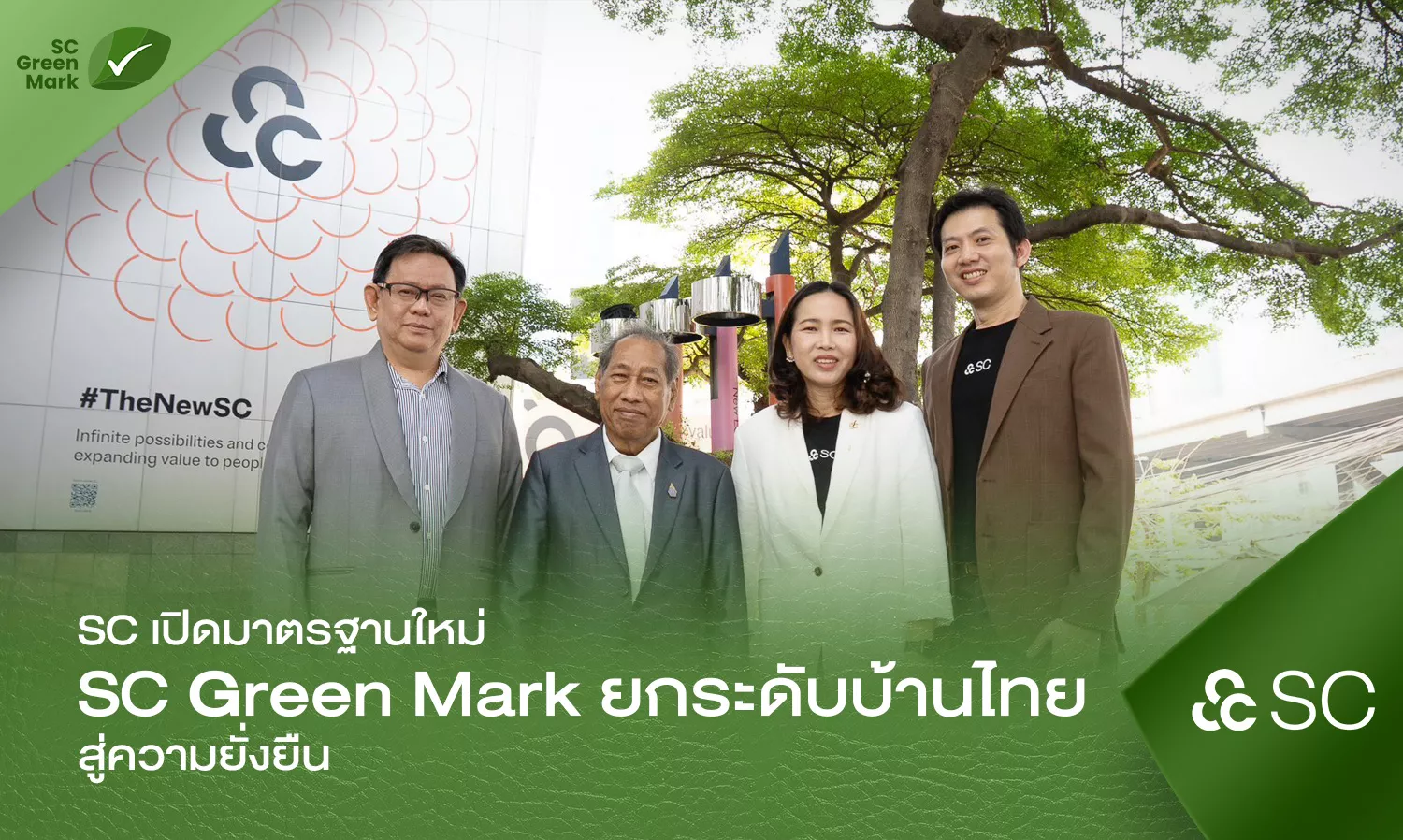
First in Real Estate! SC Partners with Green Building Institute to Develop SC Green Mark, Elevating New Standards for Sustainable Housing While Caring for Quality of Life and the Environment
SC continues to advance its strategy following a major rebranding announcement, partnering with the Thai Green Building Institute under the Thai Green Building Foundation to develop the SC Green Mark, a new standard for sustainable and environmentally friendly housing that aligns with international standards. This positions SC as the first Thai real estate company to have its own green building standard, aiming to enhance quality of life alongside environmental care, creating value for people and the planet, and laying the groundwork for a new standard in the Thai real estate industry, initially piloted in the single-family home brands "Grand Bangkok Boulevard" and "Bangkok Boulevard."
Ms. Sudarat Charoenketmongkol, Deputy Managing Director of Sustainable Organization Development at SC Asset Corporation Public Company Limited (SC), stated that following the announcement of the SC Business Direction 2026 and the major rebranding, along with plans to develop the organization's green building standards, the company is moving forward as the first real estate business leader to develop its own green building standard to create value for people and the planet under the name "SC Green Mark." The initial development of SC Green Mark will focus on single-family home projects in collaboration with the Thai Green Building Institute (TGBI) under the Thai Green Building Foundation.
"SC Green Mark is not just a concept; it is a standard we have developed for practical application in all projects, referencing international criteria such as LEED, WELL, and TREES for horizontal projects. We have collaborated with the Thai Green Building Institute to develop and assess to ensure that every component can genuinely enhance the quality of life for residents while reducing environmental impact," Ms. Sudarat said.
SC Green Mark is an extension of the SCero Mission, designed to serve as a common guideline for design teams, engineers, contractors, and procurement departments to work in the same direction from the design process, construction, living, to waste management, creating sustainable value for residents, society, and the environment in the long term, covering four main dimensions:
1. Environmental Impact Reduction – Focuses on efficient design of spaces and landscapes, selecting environmentally friendly materials, reducing greenhouse gas emissions, and promoting the use of circular materials that are durable and minimize waste in the long run.
2. Energy & Water Efficiency – Aims to reduce energy and resource consumption by designing buildings to maximize natural energy use (Passive Design), reducing reliance on air conditioning, and selecting energy-efficient materials and equipment, including water-saving fixtures and promoting renewable energy use, such as solar roofs.
3. Well-Being and Quality of Life – Enhances quality of life and well-being by designing spaces conducive to physical and mental health, such as good ventilation, appropriate natural light, green areas for relaxation, and using safe and environmentally friendly materials and products, such as Low-VOC, while supporting healthy lifestyles at all ages.
4. Innovation – Incorporates technology and innovation to enhance modern living, such as Smart Home systems, intelligent energy management systems, maintenance alert systems via applications, and safety technologies like Face Recognition and AI Security.
Initially, SC Green Mark will be piloted in the Grand Bangkok Boulevard and Bangkok Boulevard project brands, with plans to expand coverage to all segments by 2027. Associate Professor Sirivathan Chaiyachana, Chairman of the Thai Green Building Foundation, stated that the foundation plays a role in developing and assessing the SC Green Mark standards to align with Thailand's green building criteria and connect with international standards. This collaboration with SC serves as an important example of the private sector taking serious steps to develop its own standards.
"This collaboration will elevate Thailand's green building standards from conceptual levels to practical implementation. The SC Green Mark serves as a model that reflects how real estate development can balance environmental concerns, quality of life, and business viability simultaneously," Associate Professor Sirivathan said. Furthermore, the development of these standards will help reduce greenhouse gas emissions, support efficient resource use, and prepare the Thai real estate sector for future sustainability trends, including regulations, access to green financing, and consumer demand for environmentally friendly housing.
The Thai Green Building Institute is an independent, non-profit organization operating under the Thai Green Building Foundation, formed by a group of volunteers consisting of architects and engineers from two professional associations: the Association of Siamese Architects under the Royal Patronage and the Engineering Institute of Thailand under the Royal Patronage, aiming to establish a Thai green building agency to develop knowledge and create standards and criteria for green buildings in Thailand, reducing the country's trade and economic disadvantages.